
Enzo Cucchi is one of the most influential Italian artists of the late twentieth and early twenty-first centuries, a central protagonist of the Italian Transavanguardia and one of the artists who played a decisive role in restoring painting, figuration, and myth to the forefront of international contemporary art at the turn of the 1980s. His practice encompasses expressive painting, drawing, sculpture, ceramics, mosaic, and architectural projects, forming a powerful and deeply personal visual mythology in which antiquity and Christian symbolism, nature and the body, memory and visionary experience coexist within a single imaginative universe. MAXXI has described Cucchi as one of the most prolific and innovative artists on the contemporary scene and as an extraordinary inventor of powerful and enigmatic images.
Enzo Cucchi was born on 14 November 1949 in Morro d’Alba, a small town in Italy’s Marche region. He did not follow a conventional academic path: as a young man, he worked alongside restorers of paintings and books and taught himself to paint. His earliest creative commitment was to literature and poetry, and in 1976 he published the volume Il veleno è stato sollevato e trasportato. This relationship with the written word would remain fundamental to his visual practice; MAXXI continues to emphasize that Cucchi’s artistic research is rooted in poetry and language.
During the mid-1970s, Cucchi increasingly spent time in Rome and returned with renewed intensity to visual art. In 1977, he held his first solo exhibition at Galleria Luigi de Ambrogi in Milan and exhibited a group of drawings at Incontri Internazionali d’Arte in Rome. During these years he met the critic Achille Bonito Oliva and entered into dialogue with the artists with whom he would soon become associated in one of the defining European movements of the late twentieth century.
In 1979, Achille Bonito Oliva coined the term Transavanguardia in relation to the work of Cucchi, Sandro Chia, Francesco Clemente, Nicola De Maria, and Mimmo Paladino. At the 1980 Venice Biennale, Aperto ’80, organized by Bonito Oliva and Harald Szeemann, provided a decisive international platform for the emerging movement. The official history of La Biennale di Venezia identifies this section as the context in which the Transavanguardia came to prominence.
The Transavanguardia emerged at a moment when much of the art world had been shaped by Conceptualism, Minimalism, and the dematerialization of the art object. Cucchi and his contemporaries reopened painting to figuration, emotion, historical memory, mythology, and individual imagination. Centre Pompidou later emphasized the movement’s role in making figurative, narrative, and emotionally charged painting newly viable at a time when painting itself had repeatedly been declared exhausted.
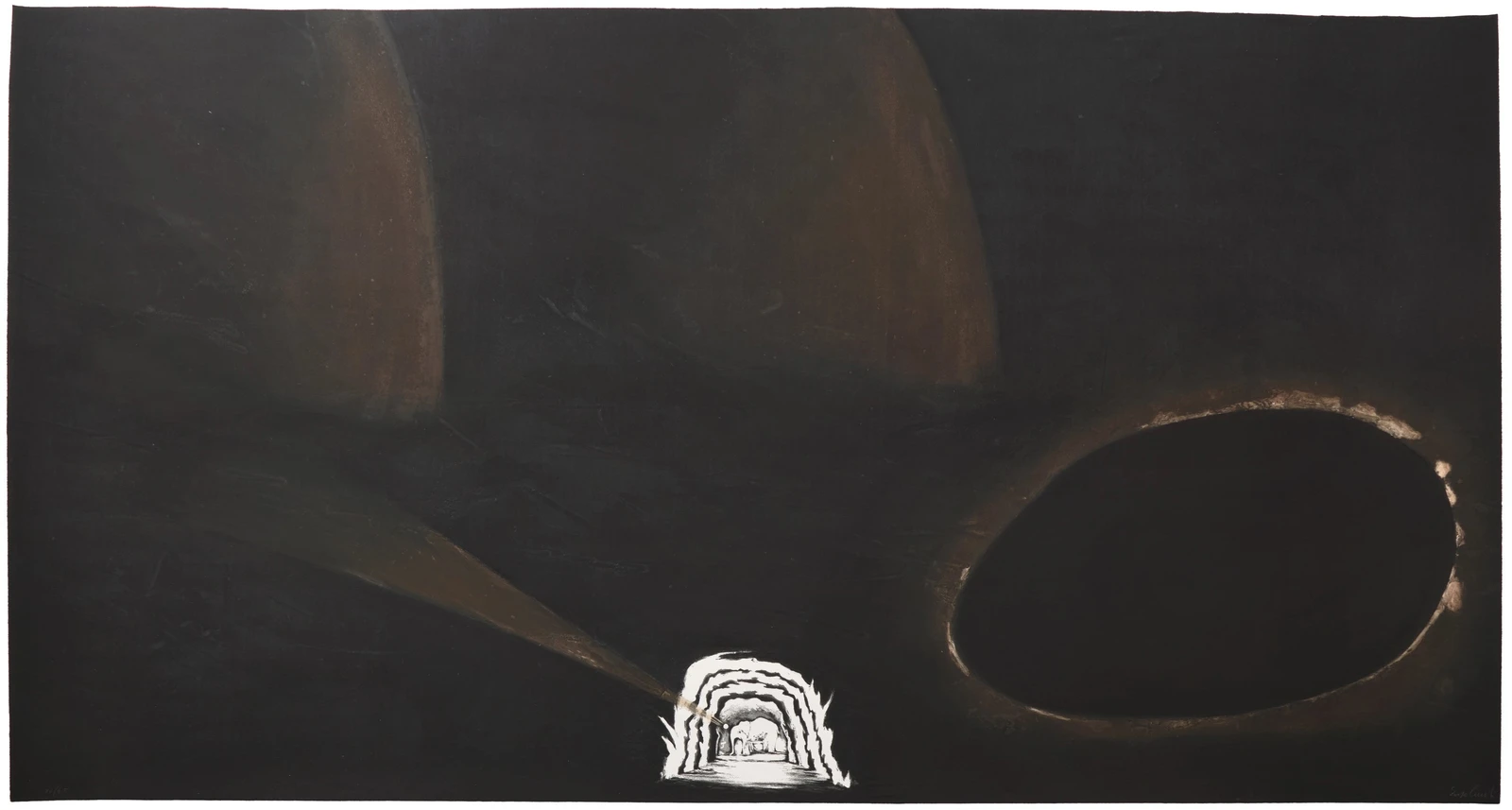
Yet Cucchi’s work has never been reducible to a collective style. He developed an unmistakable iconography of skulls, bones, fire, eyes, heads, animals, boats, houses, trees, mountains, stars, and signs, recurring across his work like fragments of an ancient language or personal prophecy. These symbols resist fixed interpretation, moving continually between the sacred and the corporeal, life and death, memory and dream. MAXXI describes his practice as bringing together dreamlike visions, the mystical and religious popular culture of his homeland, art history, classical literature, and mythology, synthesizing individual myths with collective imagination.
The landscape of the Marche and the Adriatic occupies a particularly important place in this mythology. For Cucchi, his native territory is not simply a geographical subject but an almost metaphysical terrain. Hills, sea, earth, sacred sites, trees, and the architecture of central Italy become spaces in which the present intersects with archaic memory. His early print portfolio Immagine Feroce (1981) already includes works such as Tutte le montagne sono sante (“All Mountains Are Saints”) and Il santo di Loreto, directly connecting his imagery to the cultural and spiritual landscape of the Marche. These works are now held by the National Gallery of Art in Washington, D.C.
Cucchi’s international recognition accelerated rapidly at the beginning of the 1980s. He participated in the 15th São Paulo Biennial in 1979, the Venice Biennale and Biennale de Paris in 1980, Documenta 7 in Kassel and the 4th Biennale of Sydney in 1982; that same year he held a solo exhibition at Kunsthaus Zürich. In 1984 his work was shown at the Institute of Contemporary Art, Boston, followed by major presentations at the Louisiana Museum of Modern Art and CAPC Bordeaux in 1985.
1986 marked a defining moment in Cucchi’s international career: major solo museum exhibitions were presented at both the Solomon R. Guggenheim Museum in New York and the Musée national d’art moderne — Centre Georges Pompidou in Paris. The Paris exhibition brought together approximately fifty paintings and drawings. Cucchi’s monumental Deposito occidentale of the same year was installed in the Guggenheim rotunda and is now part of the collection of the Guggenheim Museum Bilbao.
The scale of Cucchi’s thinking is particularly evident in works that move beyond the conventional boundaries of painting. The Museum of Modern Art holds the monumental The Days Must Be Laid on the Ground (1983), a composition of two canvases and painted metal extending more than six meters, as well as Vitebsk-Harar (1984), in which the painted field is physically joined to an iron structure. Such works demonstrate how naturally, in Cucchi’s practice, painting expands into object, sculpture, and architectural space.
Over subsequent decades, Cucchi continued to extend this approach into architecture and public space. In collaboration with architect Mario Botta, he created the artistic program for the Church of Santa Maria degli Angeli on Monte Tamaro, Switzerland, integrating paintings and twenty-two panels directly into the sacred architecture. In 1999 he created the monumental Tel Aviv–Yafo Mosaic specifically for the Tel Aviv Museum of Art, where it remains in the museum’s sculpture garden. He later contributed as an artist to the Church of San Giacomo Apostolo in Ferrara, designed by Benedetta Tagliabue / EMBT.
Cucchi has worked across an exceptional range of materials and formats—canvas, paper, bronze, terracotta, ceramics, marble, iron, steel mesh, mosaic, and the artist’s book. For him, moving between mediums does not mean changing artistic languages: painting, drawing, sculpture, and architecture function as different manifestations of a continuous imaginative system. This extraordinary breadth became the focus of the major 2023 exhibition Enzo Cucchi. The Poet and the Magician at MAXXI, the National Museum of 21st Century Arts in Rome. Bringing together more than 200 works, from monumental pieces and paintings to drawings, bronzes, ceramics, prints, and artist’s books, the exhibition surveyed Cucchi’s practice from the 1970s to the present.
Cucchi’s work is represented in major international museum collections. The Museum of Modern Art (MoMA) in New York currently catalogs nine works by the artist online; significant holdings can also be found at Centre Pompidou, Guggenheim Bilbao, the Walker Art Center, the National Gallery of Art, the Art Institute of Chicago, Tate, and other leading institutions across Europe, the United States, Australia, and Asia.
Today, Enzo Cucchi occupies a central place in the history of European art from the late twentieth century to the present. As one of the defining figures of the Transavanguardia, he participated in a fundamental rethinking of what painting could mean after Conceptualism, yet the scope of his practice has long exceeded the boundaries of any single movement. For more than five decades, Cucchi has constructed an artistic cosmology of his own—deeply rooted in Italy, its land, religion, literature, and art history, yet universal in its engagement with memory, mortality, nature, the body, and the mystery of existence. In Cucchi’s art, the image is never merely illustrative; it appears as a vision—an autonomous reality in which ancient and contemporary, sacred and earthly, personal and collective experience are brought together once again within the space of art.
About the artist
Enzo Cucchi
1949, Italy
Enzo Cucchi is one of the most influential Italian artists of the late twentieth and early twenty-first centuries, a central protagonist of the Italian Transavanguardia and one of the artists who played a decisive role in restoring painting, figuration, and myth to the forefront of international contemporary art at the turn of the 1980s. His practice encompasses expressive painting, drawing, sculpture, ceramics, mosaic, and architectural projects, forming a powerful and deeply personal visual mythology in which antiquity and Christian symbolism, nature and the body, memory and visionary experience coexist within a single imaginative universe. MAXXI has described Cucchi as one of the most prolific and innovative artists on the contemporary scene and as an extraordinary inventor of powerful and enigmatic images.
Enzo Cucchi was born on 14 November 1949 in Morro d’Alba, a small town in Italy’s Marche region. He did not follow a conventional academic path: as a young man, he worked alongside restorers of paintings and books and taught himself to paint. His earliest creative commitment was to literature and poetry, and in 1976 he published the volume Il veleno è stato sollevato e trasportato. This relationship with the written word would remain fundamental to his visual practice; MAXXI continues to emphasize that Cucchi’s artistic research is rooted in poetry and language.
During the mid-1970s, Cucchi increasingly spent time in Rome and returned with renewed intensity to visual art. In 1977, he held his first solo exhibition at Galleria Luigi de Ambrogi in Milan and exhibited a group of drawings at Incontri Internazionali d’Arte in Rome. During these years he met the critic Achille Bonito Oliva and entered into dialogue with the artists with whom he would soon become associated in one of the defining European movements of the late twentieth century.
In 1979, Achille Bonito Oliva coined the term Transavanguardia in relation to the work of Cucchi, Sandro Chia, Francesco Clemente, Nicola De Maria, and Mimmo Paladino. At the 1980 Venice Biennale, Aperto ’80, organized by Bonito Oliva and Harald Szeemann, provided a decisive international platform for the emerging movement. The official history of La Biennale di Venezia identifies this section as the context in which the Transavanguardia came to prominence.
The Transavanguardia emerged at a moment when much of the art world had been shaped by Conceptualism, Minimalism, and the dematerialization of the art object. Cucchi and his contemporaries reopened painting to figuration, emotion, historical memory, mythology, and individual imagination. Centre Pompidou later emphasized the movement’s role in making figurative, narrative, and emotionally charged painting newly viable at a time when painting itself had repeatedly been declared exhausted.
Yet Cucchi’s work has never been reducible to a collective style. He developed an unmistakable iconography of skulls, bones, fire, eyes, heads, animals, boats, houses, trees, mountains, stars, and signs, recurring across his work like fragments of an ancient language or personal prophecy. These symbols resist fixed interpretation, moving continually between the sacred and the corporeal, life and death, memory and dream. MAXXI describes his practice as bringing together dreamlike visions, the mystical and religious popular culture of his homeland, art history, classical literature, and mythology, synthesizing individual myths with collective imagination.
The landscape of the Marche and the Adriatic occupies a particularly important place in this mythology. For Cucchi, his native territory is not simply a geographical subject but an almost metaphysical terrain. Hills, sea, earth, sacred sites, trees, and the architecture of central Italy become spaces in which the present intersects with archaic memory. His early print portfolio Immagine Feroce (1981) already includes works such as Tutte le montagne sono sante (“All Mountains Are Saints”) and Il santo di Loreto, directly connecting his imagery to the cultural and spiritual landscape of the Marche. These works are now held by the National Gallery of Art in Washington, D.C.
Cucchi’s international recognition accelerated rapidly at the beginning of the 1980s. He participated in the 15th São Paulo Biennial in 1979, the Venice Biennale and Biennale de Paris in 1980, Documenta 7 in Kassel and the 4th Biennale of Sydney in 1982; that same year he held a solo exhibition at Kunsthaus Zürich. In 1984 his work was shown at the Institute of Contemporary Art, Boston, followed by major presentations at the Louisiana Museum of Modern Art and CAPC Bordeaux in 1985.
1986 marked a defining moment in Cucchi’s international career: major solo museum exhibitions were presented at both the Solomon R. Guggenheim Museum in New York and the Musée national d’art moderne — Centre Georges Pompidou in Paris. The Paris exhibition brought together approximately fifty paintings and drawings. Cucchi’s monumental Deposito occidentale of the same year was installed in the Guggenheim rotunda and is now part of the collection of the Guggenheim Museum Bilbao.
The scale of Cucchi’s thinking is particularly evident in works that move beyond the conventional boundaries of painting. The Museum of Modern Art holds the monumental The Days Must Be Laid on the Ground (1983), a composition of two canvases and painted metal extending more than six meters, as well as Vitebsk-Harar (1984), in which the painted field is physically joined to an iron structure. Such works demonstrate how naturally, in Cucchi’s practice, painting expands into object, sculpture, and architectural space.
Over subsequent decades, Cucchi continued to extend this approach into architecture and public space. In collaboration with architect Mario Botta, he created the artistic program for the Church of Santa Maria degli Angeli on Monte Tamaro, Switzerland, integrating paintings and twenty-two panels directly into the sacred architecture. In 1999 he created the monumental Tel Aviv–Yafo Mosaic specifically for the Tel Aviv Museum of Art, where it remains in the museum’s sculpture garden. He later contributed as an artist to the Church of San Giacomo Apostolo in Ferrara, designed by Benedetta Tagliabue / EMBT.
Cucchi has worked across an exceptional range of materials and formats—canvas, paper, bronze, terracotta, ceramics, marble, iron, steel mesh, mosaic, and the artist’s book. For him, moving between mediums does not mean changing artistic languages: painting, drawing, sculpture, and architecture function as different manifestations of a continuous imaginative system. This extraordinary breadth became the focus of the major 2023 exhibition Enzo Cucchi. The Poet and the Magician at MAXXI, the National Museum of 21st Century Arts in Rome. Bringing together more than 200 works, from monumental pieces and paintings to drawings, bronzes, ceramics, prints, and artist’s books, the exhibition surveyed Cucchi’s practice from the 1970s to the present.
Cucchi’s work is represented in major international museum collections. The Museum of Modern Art (MoMA) in New York currently catalogs nine works by the artist online; significant holdings can also be found at Centre Pompidou, Guggenheim Bilbao, the Walker Art Center, the National Gallery of Art, the Art Institute of Chicago, Tate, and other leading institutions across Europe, the United States, Australia, and Asia.
Today, Enzo Cucchi occupies a central place in the history of European art from the late twentieth century to the present. As one of the defining figures of the Transavanguardia, he participated in a fundamental rethinking of what painting could mean after Conceptualism, yet the scope of his practice has long exceeded the boundaries of any single movement. For more than five decades, Cucchi has constructed an artistic cosmology of his own—deeply rooted in Italy, its land, religion, literature, and art history, yet universal in its engagement with memory, mortality, nature, the body, and the mystery of existence. In Cucchi’s art, the image is never merely illustrative; it appears as a vision—an autonomous reality in which ancient and contemporary, sacred and earthly, personal and collective experience are brought together once again within the space of art.
Selected Artworks
1