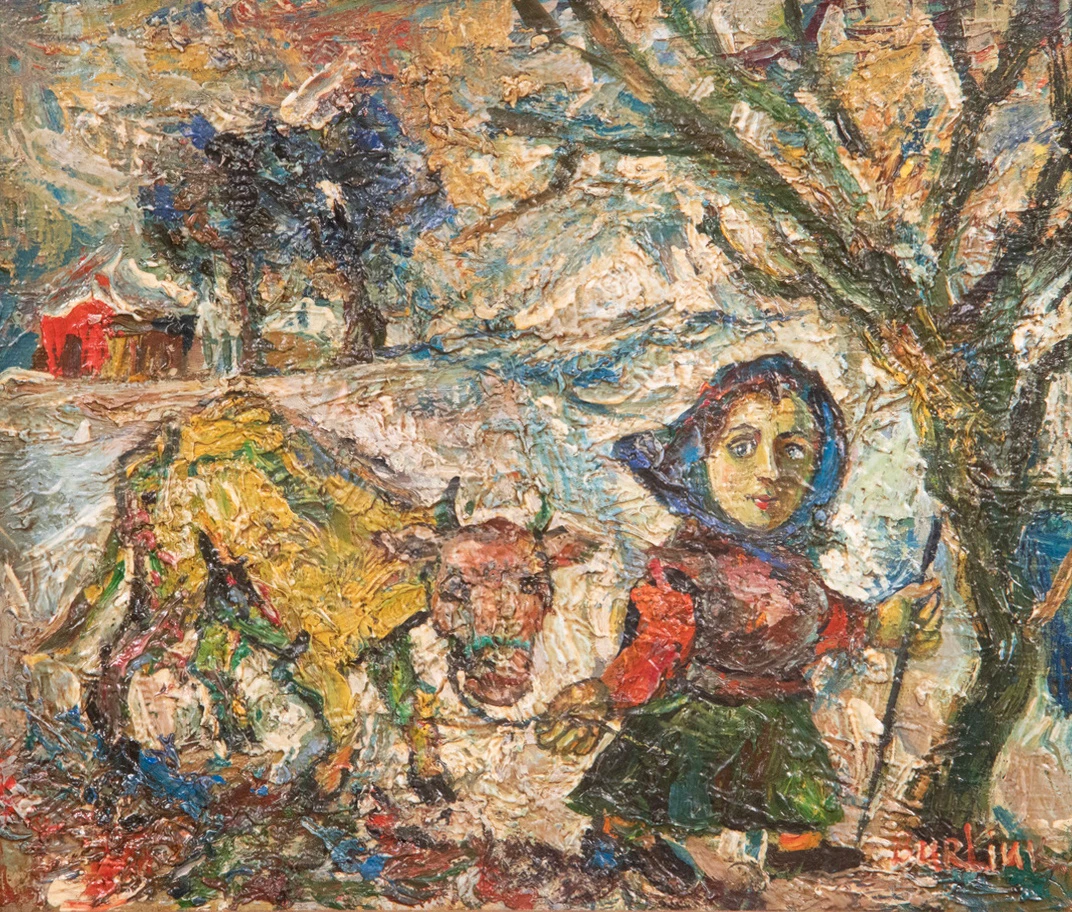
Woman with Cow Passing Tree
c. 1940s
Oil on canvas
About the work
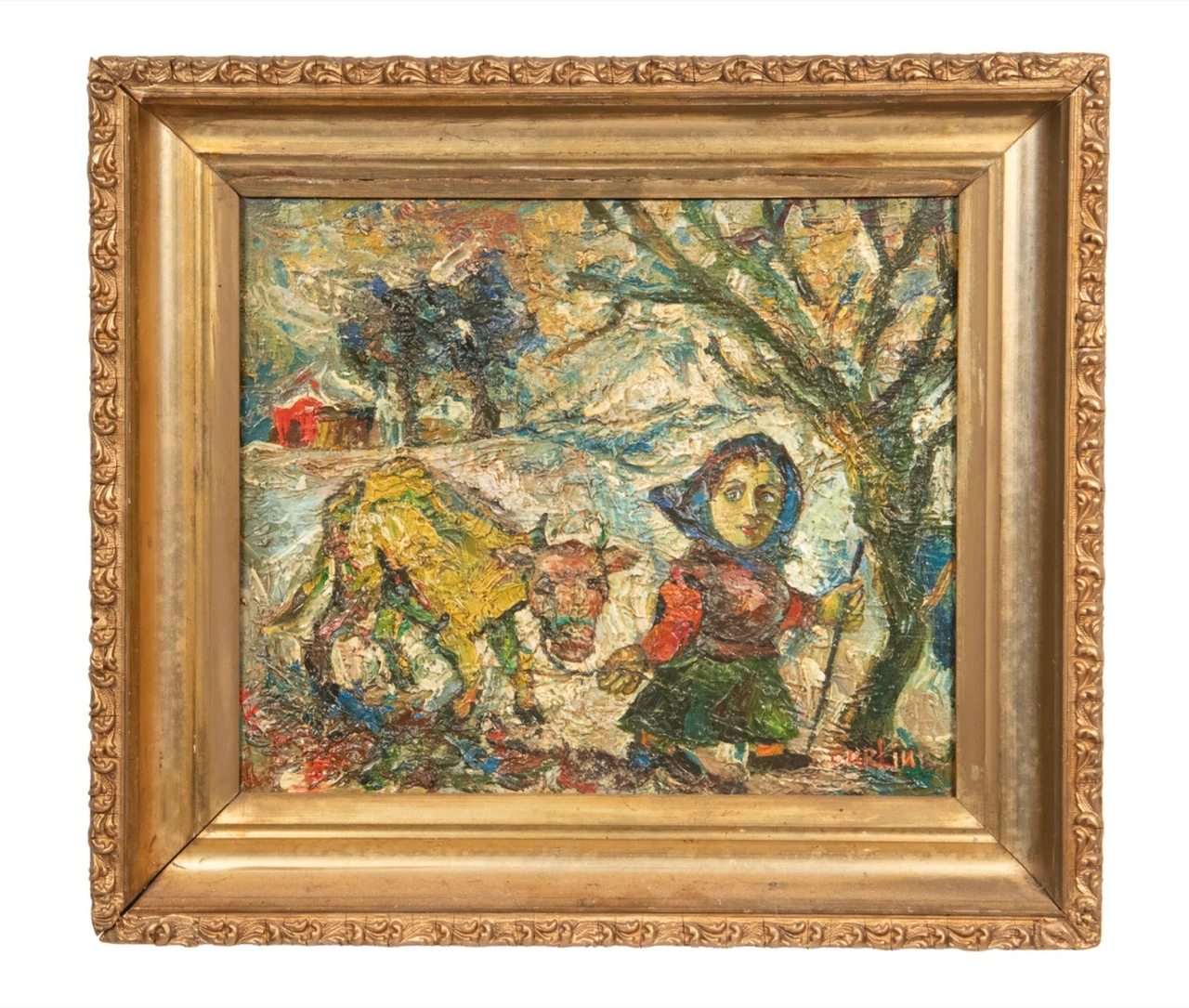
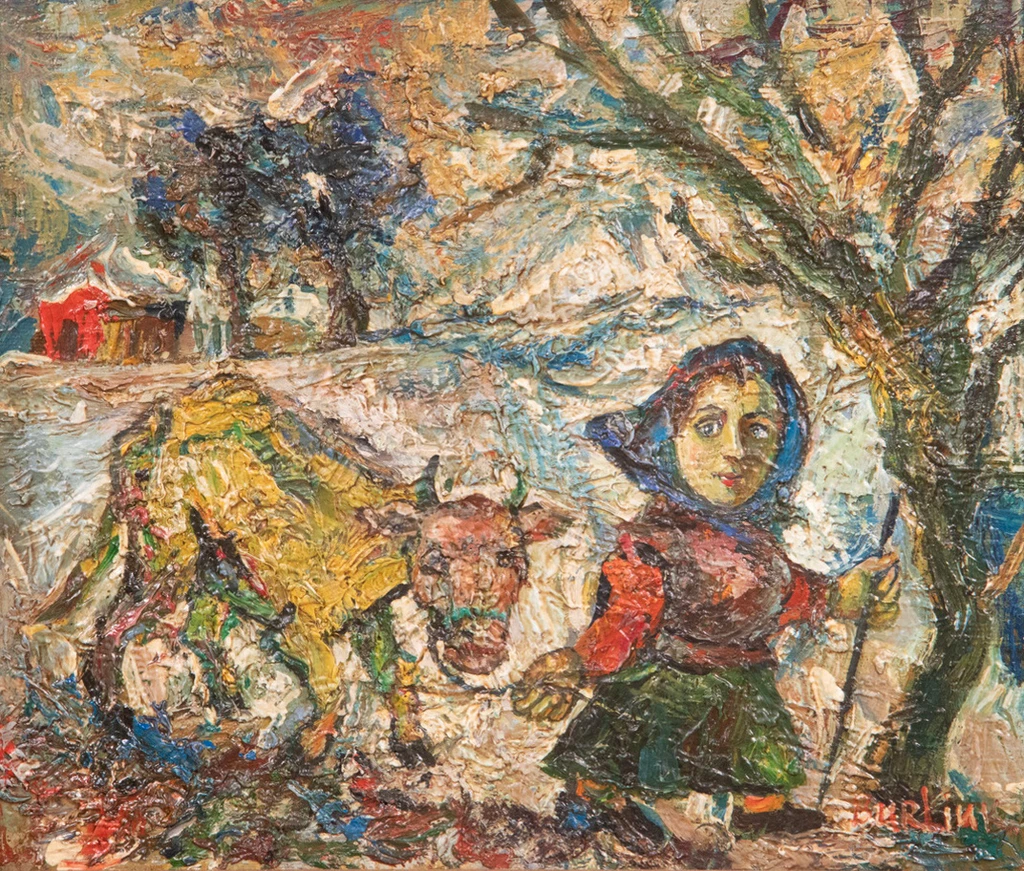
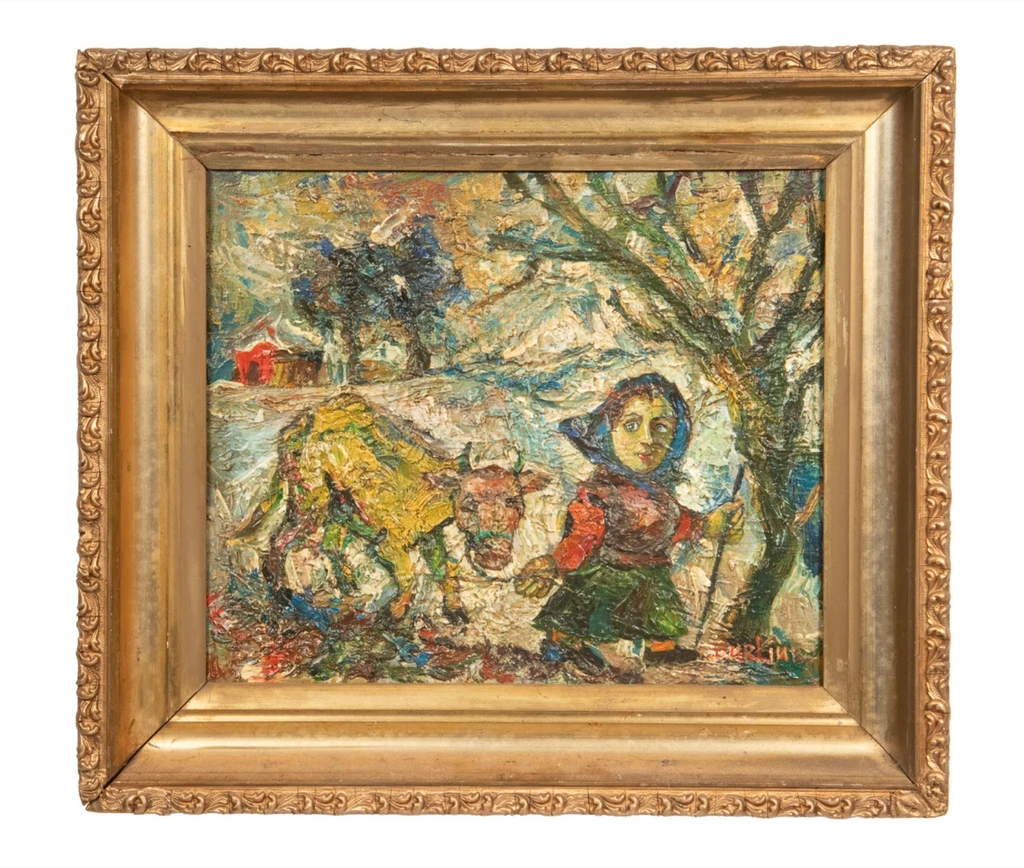
In Woman with Cow Passing Tree, David Burliuk returns to one of the most resonant motifs of his mature practice: a pastoral world in which the human figure, animal, and landscape are brought together into an almost archetypal image of rural life.
A headscarved woman leads a pale cow beneath the spreading canopy of a tree. The apparent simplicity of the scene becomes the foundation for an intensely physical act of painting. Energetic contours, saturated color, and densely worked layers of pigment give the surface a palpable, almost sculptural presence. The woman’s large almond-shaped eyes, deliberately simplified forms, and directness of expression create the distinctive combination of Neo-Primitivist freedom, expressive force, and psychological tension that characterizes Burliuk’s mature figurative language.
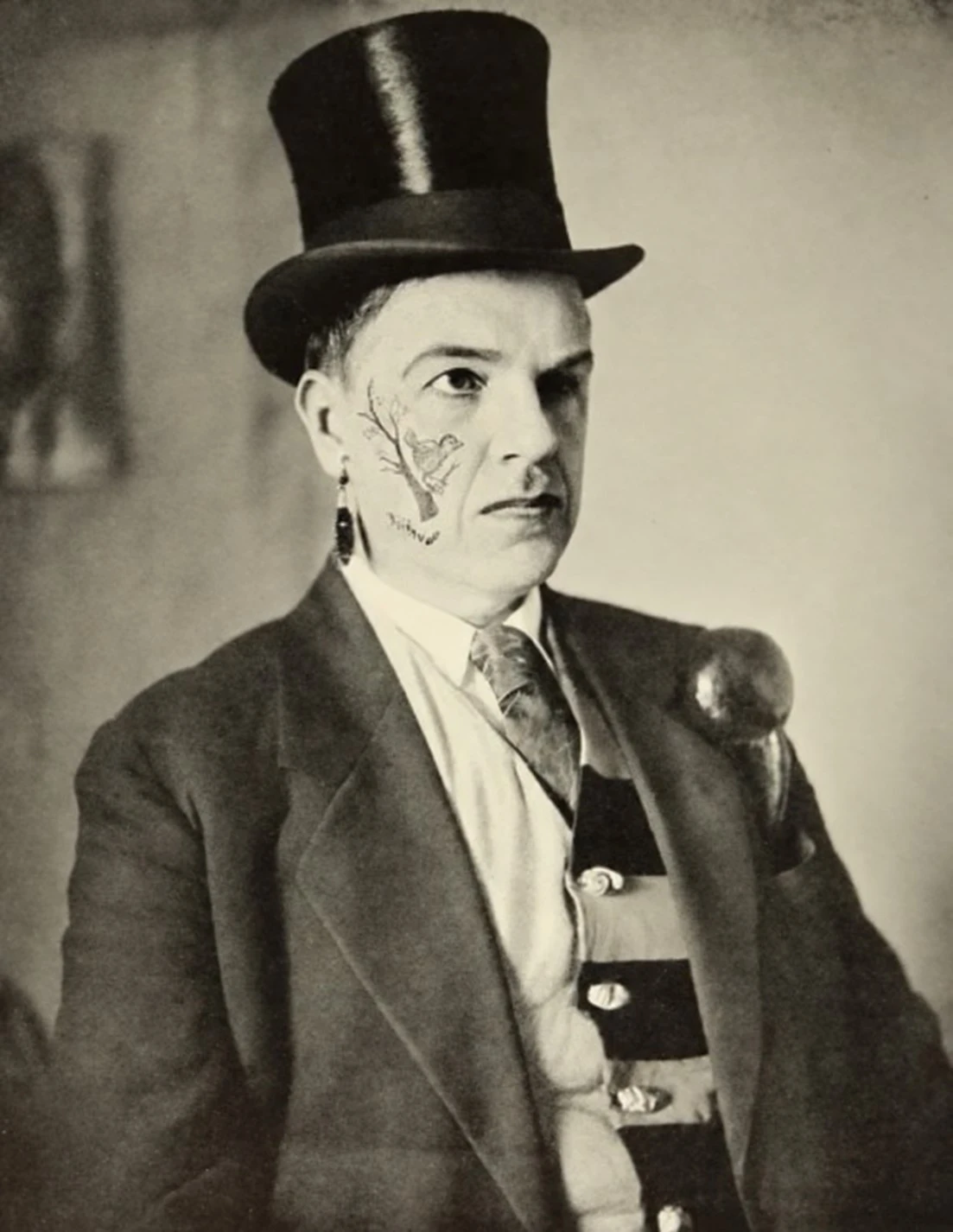
Underlying the pastoral subject is one of the enduring themes of Burliuk’s art: the memory of the Ukrainian steppe and the culture that shaped his artistic imagination. Born in what is now Ukraine’s Sumy region and descended from a family of Zaporozhian Cossacks, Burliuk drew from Cossack history, Scythian antiquity, vernacular imagery, and the landscape of the steppe from the beginning of his career. Scholars have noted that he mythologized his steppe homeland as a source of the elemental force and “primitivism” he sought in art.
This imaginative world endured after Burliuk moved to the United States in 1922. Living first in New York and, from 1941, in Hampton Bays on Long Island, he continued to return to nature, rural subjects, and the elemental relationship between human life and the land. Energy, vitality, and an enduring connection to nature remained constants within his work across changing styles and continents.
Significantly, this pastoral vocabulary has a direct institutional context. The Whitney Museum of American Art in New York holds Burliuk’s large-scale painting The White Cow (1936), in which human figures and a white cow similarly form the compositional focus. The collection of the Hirshhorn Museum and Sculpture Garden, Smithsonian Institution, Washington, D.C., includes Peasant and Cows and Milk Maid, works that extend the same rural and pastoral iconography. Both Hirshhorn works entered the museum through the collection of Joseph H. Hirshhorn.
Seen in this context, Woman with Cow Passing Tree is not simply an isolated genre scene, but belongs to a sustained and recognizable strand of Burliuk’s mature oeuvre—one with direct parallels in major American museum collections.
The particular strength of the painting lies in this convergence of histories. It is a work by a central figure of the international avant-garde, created during his mature American period yet deeply connected to the culture, landscape, and visual memory of Ukraine. Within its intimate scale, Burliuk concentrates essential qualities of his pictorial language: the physical presence of paint, freedom of form, intensity of color, and the almost archetypal directness of the image.
Woman with Cow Passing Tree is a compelling and highly representative example of Burliuk’s mature work, bringing Ukrainian cultural memory, the experience of the international avant-garde, and the artist’s American period into a single concentrated image. Its close iconographic relationship to works held by the Whitney Museum of American Art and the Hirshhorn Museum and Sculpture Garden gives the painting particular resonance both for a focused private collection of modernism and the avant-garde and for an institutional collection concerned with Ukrainian art, international modernism, and the transatlantic artistic histories of the twentieth century.